
Leonid’s mission is to make Low Earth Orbit a safe, predictable place to fly. Today we’re releasing the foundation of all our products: Space Weather Forecasts of F10.7 solar flux and the geomagnetic Ap index, with the lowest error over all time horizons of any forecast model we’ve tested.
Alongside it, we’re publishing our validation report and sharing our forecasts for Solar Cycles 26 and 27.
Top-Line Results
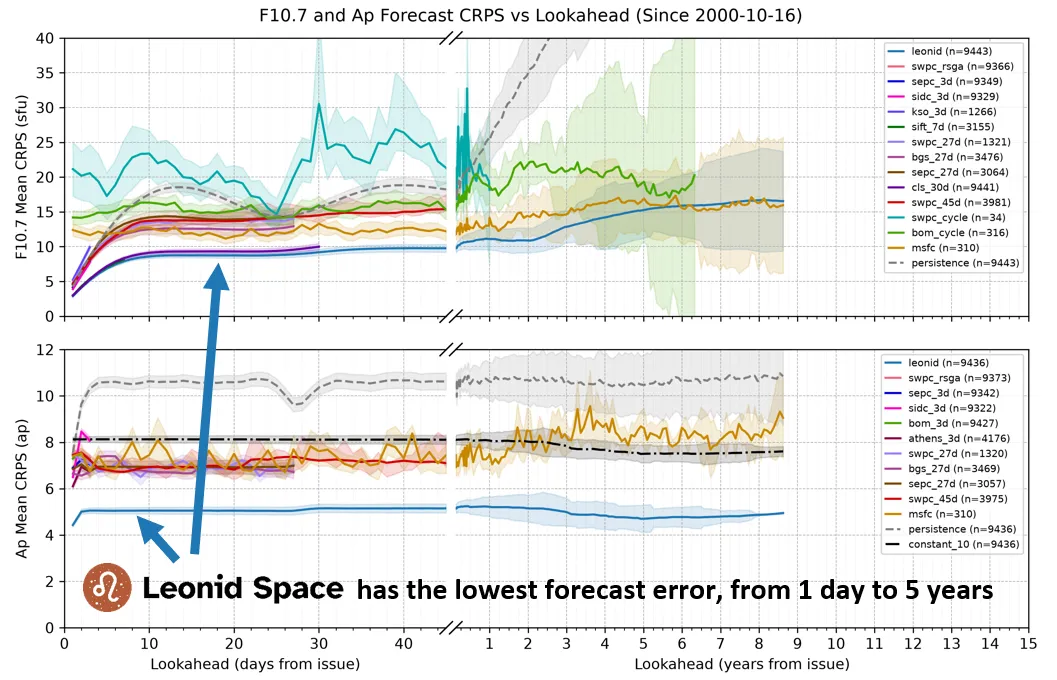
Our report scores our model against every publicly available space weather forecast archive, looking ahead from 1 day in the future to 15 years out. Here’s how next-day forecasts compare against NOAA’s Space Weather Prediction Center (SWPC) over every forecast issued since 2000:
| 1-Day Forecast Error (CRPS, lower is better) | F10.7 (sfu) | Ap |
|---|---|---|
| Leonid | 2.9 | 4.4 |
| SWPC/USAF RSGA | 4.2 | 7.5 |
| SWPC 45-Day | 4.7 | 7.5 |
| SWPC 27-Day | 4.9 | 7.5 |
That’s 30% - 40% lower F10.7 and Ap error than the leading US space weather forecasters. And while these others are issued daily, Leonid reconditions on measured data every 3 hours, so our forecasts react to changing storm conditions in real time.
Across more than two dozen forecast archives from NASA, NOAA, the USAF, and international agencies, Leonid is strictly better at predicting Ap at all time horizons, and strictly better for F10.7 out to 5 years, beyond which it ties NASA’s MSAFE.
205 Years of Retro-Forecasts
Scoring any single prediction is meaningless. A single successful forecast can not be disentangled from luck, and validating a forecast model requires scoring large collections of forecasts. However, most archives extend back to the 1990’s at most. We built an extensive retro-forecast archive that covers F10.7 back to 1821 (19 solar cycles) and Ap back to 1870, using sunspot counts and the aa index as proxies to extend the measured F10.7 and Ap records.
Every retro-forecast screens out information that wasn’t available at the time. A forecast issued in 1980 excludes 1980-1996 data from our model fit, conditions only on prior data, and is scored against what actually happened. This brings state-of-the-art statistical rigor from fields such as hurricane prediction into the domain of space weather forecasting.
Solar Cycles 26 and 27
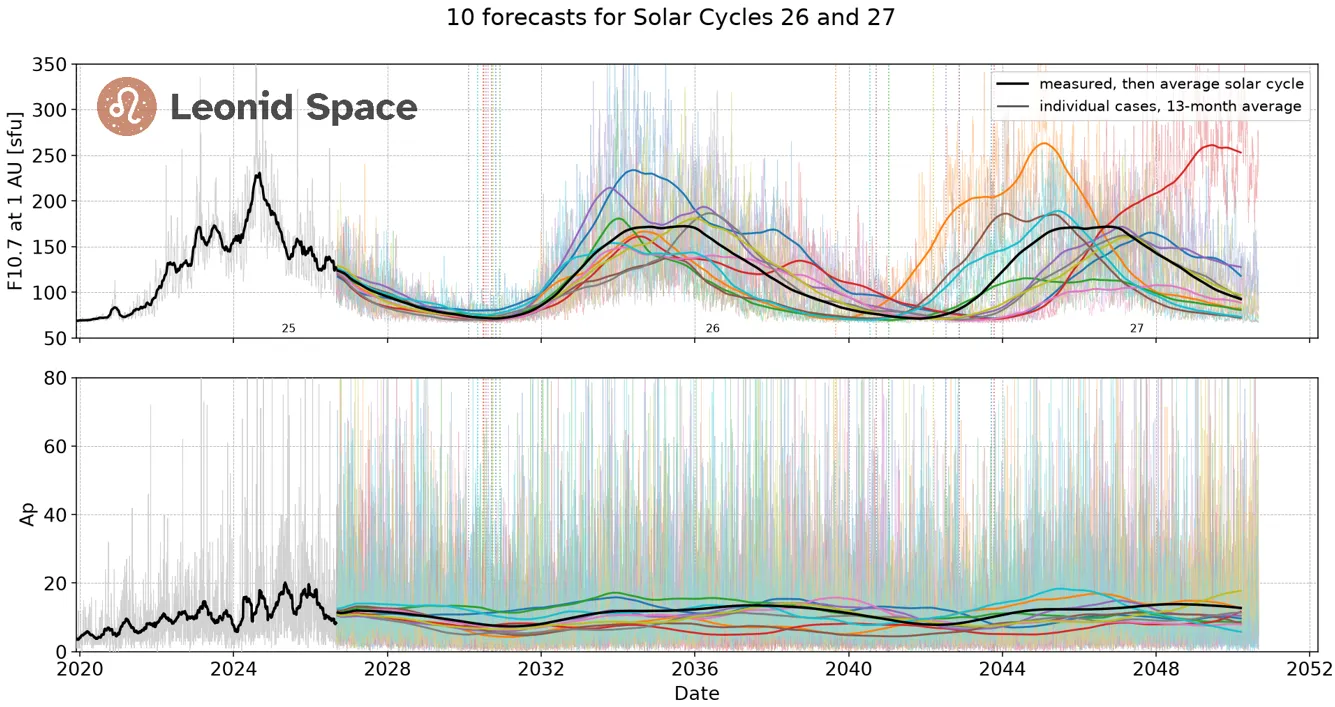
What will the next solar cycle look like?
The consensus forecast for the current Solar Cycle 25 predicted a weak cycle. But the Sun instead ran 5 standard deviations above the forecast mean, costing the space industry at bare minimum $0.88 billion in lost mission life. Our goal is to provide an ensemble of forecasts that realistically bound all potential futures. Point estimates and normal-distribution uncertainty ranges aren’t adequate.
Our model captures variation in strength, shape, and timing of each cycle, and forecasts F10.7 and Ap jointly so that high solar activity is reflected in both flux and storms. We chain cycles together so that you get the full range of short and long, strong and weak, flat and peaked future pairings. And it’s the same unified model as our next-day forecasts, capturing both long-term trends and short-duration storms. This offers solar cycle realism that other tooling does not provide.
One Forecast for All Our Products
We originally built this model to improve our deorbit predictions, after our lifetime validation showed that ~90% of our prediction error came from the MSAFE solar flux forecasts we were using. The same techniques turned out to work even better in the near term.
Space Weather Indices are now available as a standalone product via API, as probabilistic ensembles with calibrated uncertainty. These forecasts also drive the rest of our prediction products:
- Atmospheric Density - whole-Earth density anchored against drag from over 2000 satellites.
- Orbit Predictions - rapid real-time orbit propagation with our best-in-class drag models.
- Lifetime Monitoring - know when your satellites will deorbit while you still have time to act.
From the hours-to-days timeframe of collision avoidance and target tracking, to mission lifetime assurance over decades, space weather is the critical factor to knowing where your satellite will be.
Get Started
Bring the world’s most accurate space weather forecasts into your operations today.