
Nine months ago, we launched Leonid Space with a promise: accurate satellite lifetime predictions you can stake your business on. Today, we’re delivering the proof.
Top-Line Results
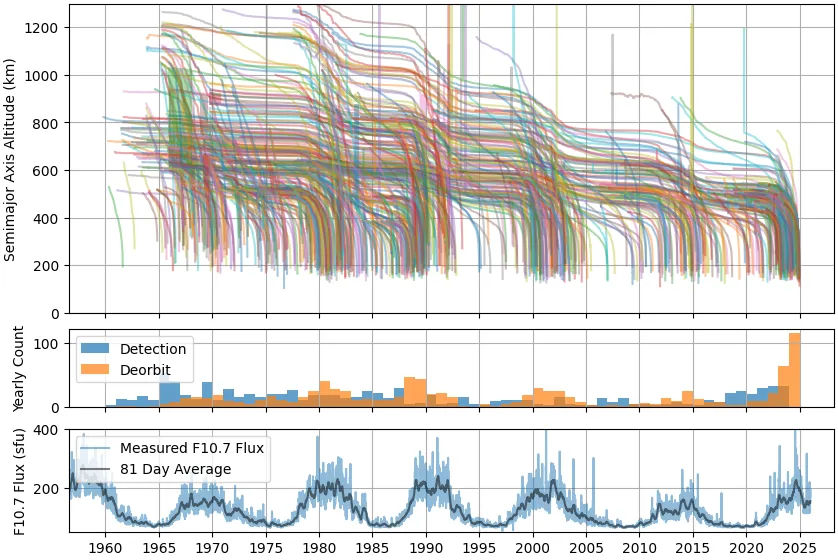
Our Validation Report documents comprehensive backtesting against 934 satellites that deorbited between 1961 and 2024, spanning six solar cycles. We tested our end-to-end prediction pipeline under three increasingly realistic scenarios:
| Scenario | 1-Year Deorbit Accuracy |
|---|---|
| Perfect Knowledge | 6.0 days (1.6%) |
| Historical Conditions | 18.6 days (5.1%) |
| Fully Predictive | 45.5 days (12.4%) |
Perfect Knowledge uses actual space weather data and drag characteristics extracted from each satellite’s final year of flight. It validates that our propagator and atmosphere model work correctly.
Historical Conditions estimates drag from 30 days of prior tracking data, but still uses actual space weather. This is where most published validations stop.
Fully Predictive uses only the solar cycle forecasts that were available at the time. This is how the tool actually runs in production.
That last row is the one that matters. It’s also where other validations stop short.
Beyond the State of the Art
We compared against the state-of-the-art: ESA’s DRAMA & DISCOS toolchain under historical conditions. Leonid’s predictions are 4x more accurate. And when compared to NASA’s DAS software, Leonid is 8x more accurate. This is due largely to our use of real-time on-orbit behavior to estimate ballistic coefficients, rather than relying on physical characterization data that exists for less than 2% of tracked debris objects.
But historical validation has a limitation: it tells you how well a tool would have performed if it already knew what the weather was going to be. That’s not how operations work. You don’t know next year’s solar flux when you’re planning next year’s mission.
So we kept going. Our fully predictive scenario uses only the space weather forecasts that were actually available at the time. No peeking at what the Sun actually did.
This is the first large-scale validation of lifetime predictions under fully predictive conditions.
Solar Cycle Uncertainty Dominates
The validation campaign confirmed something we suspected: after ballistic coefficient estimation, solar cycle forecasting dominates all other error sources. Higher-fidelity propagators, additional atmosphere models, more force terms - none of it moves the needle compared to getting the space weather right.
This is why we prioritize solar cycle modeling and probabilistic forecasts. Point estimates aren’t sufficient with such an active Sun. SpaceX, NASA, Capella, and Planet all learned this lesson firsthand recently when solar activity cut short their missions by years.
Performance at Scale
This is all enabled by our custom semianalytic propagator, which runs 340x faster than an Orekit reference and 55x faster than DRAMA. This speedup while maintaining accuracy is what makes true Monte Carlo analysis possible across entire constellations. We turn point estimates into calibrated probabilities, with all variance accounted for in the output distribution.
What This Means for Operators
Leonid is out of Beta. Our Lifetime Monitoring service is now backed by published, quantified accuracy metrics. When we tell you your satellite has a 90% chance of deorbiting between two dates, that confidence interval is calibrated against six decades of real historical data.
For operators managing LEO assets, this means:
- Revenue forecasting grounded in validated predictions
- Mission assurance for critical national security and science assets
- Production planning with realistic timelines
- Regulatory compliance supported by documented methodology
- Competitive intelligence on the orbital environment
The validation report is available here: leonidspace.com/lifetime_validation
And we’ve also updated our sample report: leonidspace.com/sample_report
Get Started
If you’ve been waiting for validation before committing, the wait is over. If you joined us during beta, thank you - your feedback shaped the product we’re shipping today.
Contact us to protect your assets with predictions you can trust.
When will your satellite deorbit?