
A year ago, we launched Leonid Space to tell satellite operators when their spacecraft will deorbit. We built state-of-the-art tooling, validated that it works, and provided Deorbit Reports that operators could stake their business on. But a prediction is only as current as the data behind it, and space weather is always changing.
The Problem with Snapshots
Orbital forecasts have a shelf life. Solar cycles shift, storms hit Earth, fuel levels drop, and a prediction from last quarter may no longer reflect reality. NASA’s TROPICS mission is a textbook example: initial estimates said 9 years, revised estimates said 5-6, and the actual mission lifetime was 2.5 years. That gap didn’t open all at once. It widened gradually as conditions evolved and estimates failed to keep up. If the last time you predicted your mission life was before launch, you’re likely to be surprised.
For operators whose revenue, production plans, or mission objectives depend on how long their satellites will be in space, snapshots aren’t enough.
Introducing Satellite Lifetime Monitoring
Today we’re upgrading our Deorbit Reports into a continuous service: Satellite Lifetime Monitoring. Instead of a one-time deliverable, you get real-time predictions that track your constellation through the storms.
How It Works
Monthly Prediction Refreshes
Each month, we regenerate your full constellation analysis using the latest orbital tracking data and solar cycle forecasts. You receive updated versions of the core plots from your Deorbit Report:
- Dispersed altitude traces bounding the range of possible futures for each satellite
- Cumulative deorbit probability curves showing the likelihood of reentry over time
- Constellation size projections tracking how many spacecraft remain in orbit at any given date
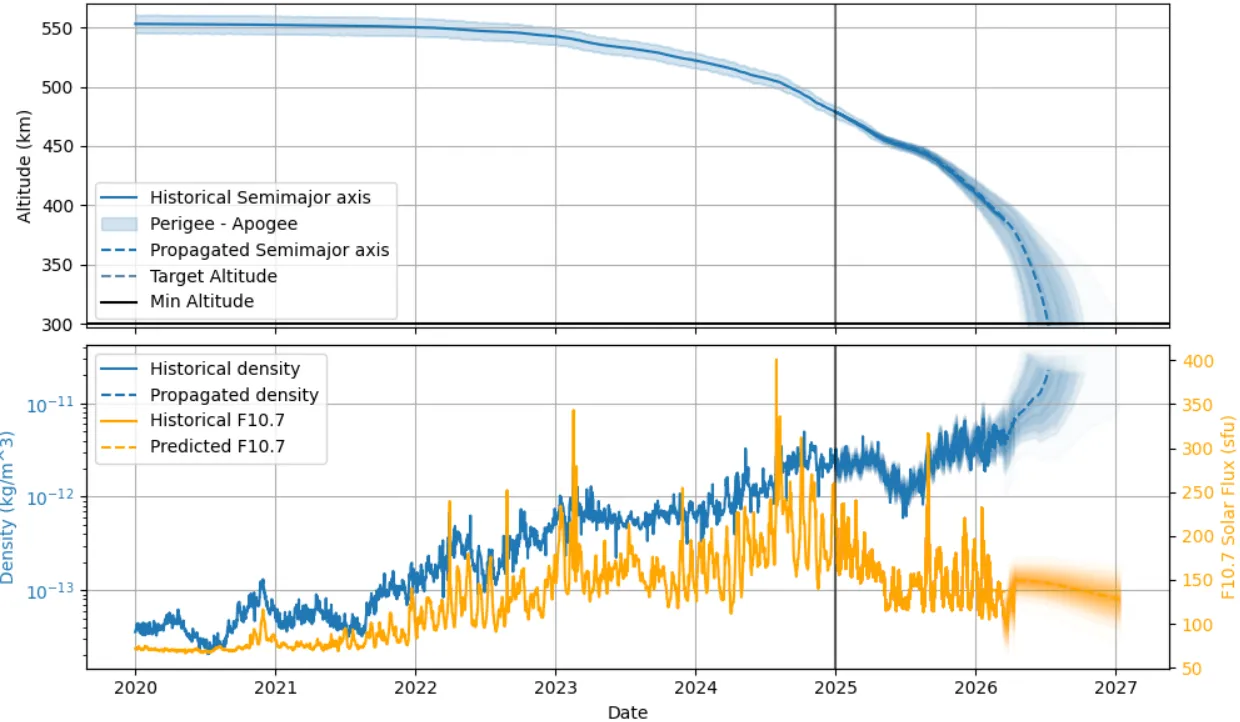
Each refresh incorporates new tracking data, the latest space weather forecasts, and any changes to your orbit control plan. As the solar cycle evolves, your predictions will evolve with it.
Real-Time Lifetime Alerts
Monthly updates keep you informed. But when conditions shift suddenly - a major geomagnetic storm, an unexpected surge in atmospheric drag - you need to know right away.
You define a threshold date for each satellite: a date that matters to your mission, whether that’s a contract commitment, a regulatory deadline, or revenue target. Then you choose which percentile to monitor - the 50th, the 90th, or whatever matches your risk tolerance.
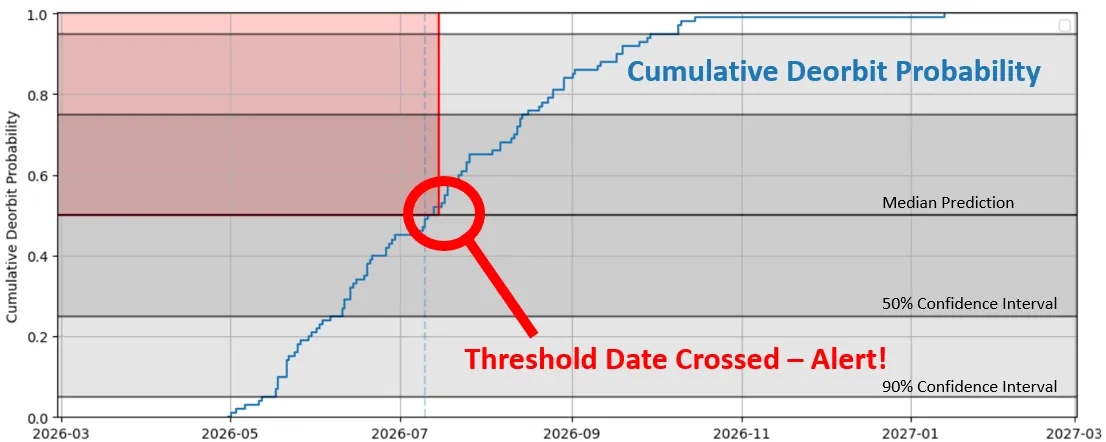
When our daily predictions show your satellite’s deorbit date crossing below that threshold, you get an email alert immediately. No waiting for the next monthly cycle. If a storm pulls your timeline forward by a month overnight, you’ll know by morning.
Annual Reports and Compliance Checks
Subscriptions also include:
- Annual constellation health reports for stakeholder and board-level planning
- FCC “5-Year Rule” compliance checks to stay ahead of post-mission disposal requirements
- Propellant and orbit control modeling incorporating your mission-specific operational details
- Future launch modeling for multi-satellite plans
- API and Dashboard access (coming soon)
All backed by state-of-the-art, published accuracy metrics validated against six decades of flight data.
Get Started
Control your operational risk as the space environment changes. Satellite lifetime now becomes a continuous input to your revenue forecasts, mission coverage, and production and staffing plans.
We provide predictable pricing that scales affordably as you add satellites. Get in touch to protect your assets with predictions you can trust.
When will your satellite deorbit?