
Starting today, Leonid’s predictions are available through the Leonid Space API. Our space weather forecasts, atmospheric density grids, and satellite orbit predictions are all now served from an on-demand REST interface, with new data refreshed every 3 hours.
You can try it right now. This gets our latest predictions for demise of the Hubble Space Telescope: https://api.leonidspace.com/v1/objects/000020580/predictions/latest/events/quantiles?event=impact&levels=0.1,0.5,0.9
"object_id": "000020580",
"levels": [0.1, 0.5, 0.9],
"case_count": 100,
"quantiles": [
  {
    "event": "impact",
    "altitude_km": 0.0,
    "epoch": {
      "0.1": "2032-12-05T16:59:05.065295Z",
      "0.5": "2034-02-02T19:31:21.540100Z",
      "0.9": "2035-03-18T04:47:27.987359Z"
    }
  }
]
Our Data
Every 3 hours we ingest real-time space weather measurements and orbital tracking data, process the entire catalog of objects in LEO, and publish a new prediction run. Each run includes three linked products:
| Product | Description | Time Horizon |
|---|---|---|
| Space Weather Indices | F10.7 solar flux and the geomagnetic Ap index | 25 years |
| Atmospheric Density | Whole-Earth thermospheric density grids, anchored by real-time orbital drag measurements | 60 days |
| Orbit Predictions | Future trajectories for tracked objects, for the next few hours out to reentry decades out | 25 years |
In addition to forecasts we also provide an archive of historical measurements: space weather indices and global density grids back to 1947, our corrected density grids back to 1967, and each object’s past orbital elements and estimates for its ballistic coefficient.
Calibrated Uncertainty
Space weather is notoriously uncertain. Our prediction pipeline is calibrated with end-to-end uncertainty realism, so that our output distribution reflects the real odds. Each of our forecasts generates 100 Monte Carlo cases so that you can analyze the full range of outcomes. Or you can query just a few quantiles for a best-case, worst-case, nominal spread. Does your tooling only run a single forecast at a time? Plug in just the median 0.5 quantile.
The data for a prediction run is crosslinked - case 7 of a trajectory flew through case 7 of the forecasted density, which was driven by case 7 of the space weather forecast. We maintain full tracability for all predictions, and you can run your own tools on each piece of our component data.
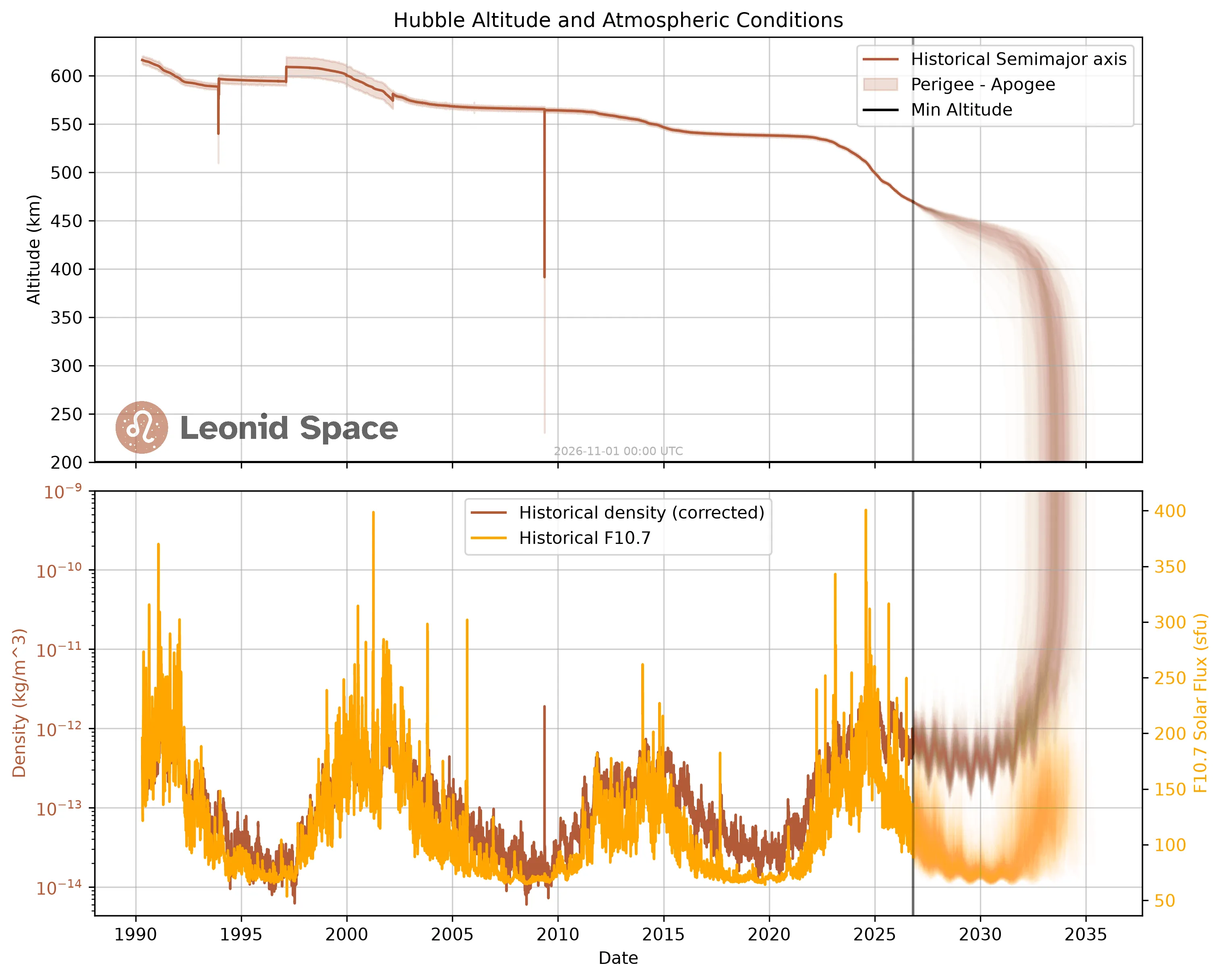
Some plots are immediately directly through the API - we generate plots for each object that show altitude curves, impact maps, and prediction histories.
Built for Automated Operations
- Real-time predictions - The “latest” endpoint always points at the newest 3-hour run.
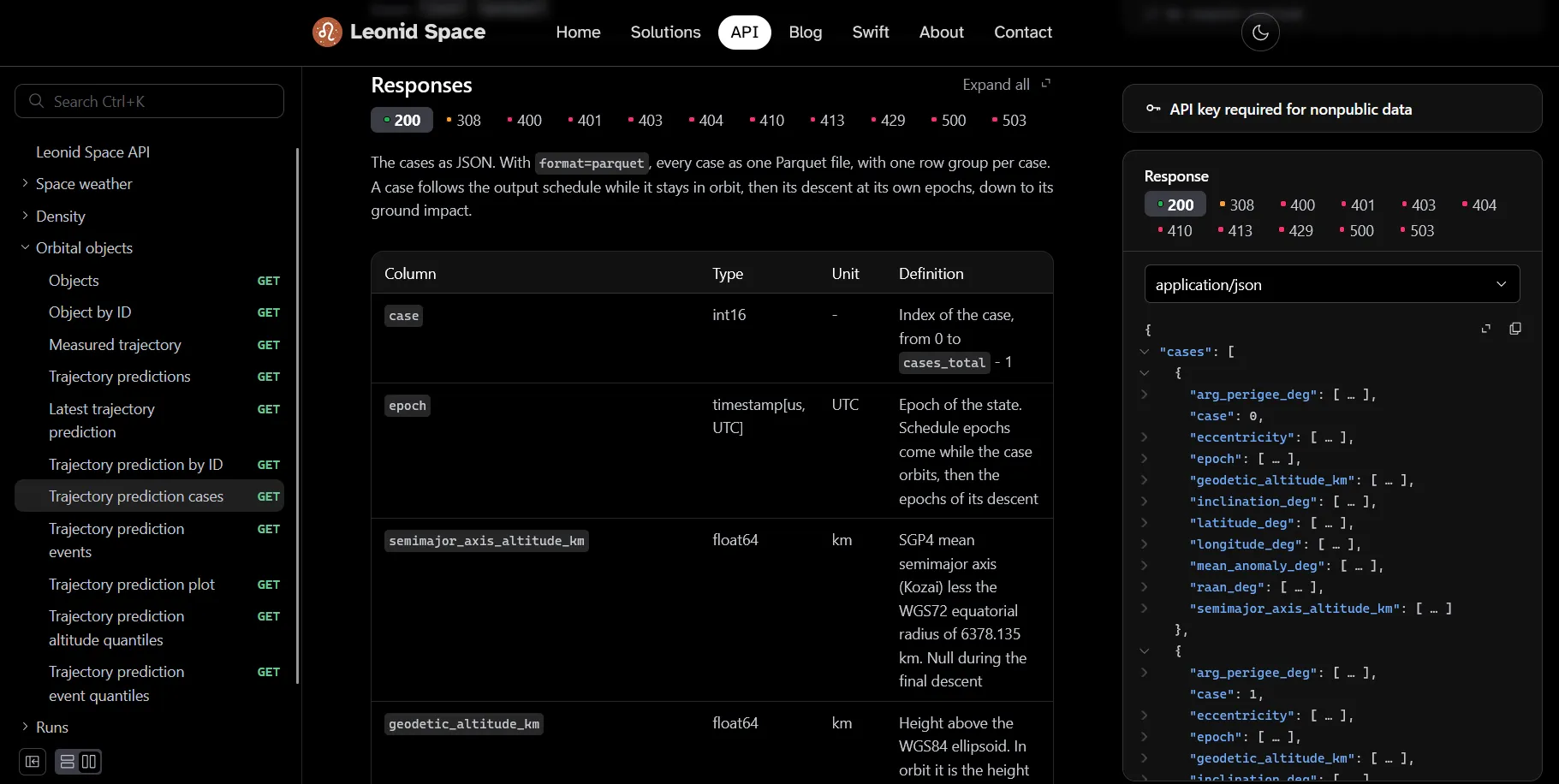
- Open schema - See our API Guide, full API Reference, or machine-readable openapi.json.
- Common data formats - Filter JSON responses by case, column, and time window, or download bulk predictions as Parquet binaries.
- Fully Documented - Time systems, coordinate frames, units, and data rates are detailed in the API guide, with Python scripting examples.
Free to Try
The first 5 cases of our live predictions for Hubble and Swift are public, along with the most recent month of space weather indices and uncorrected density grids. The API guide has Python examples for you to experiment with querying and using the data.
A paid API key unlocks the rest:
- All 100+ prediction cases
- World’s most accurate space weather and global density forecasts
- The full historical record of data
- Ballistic coefficient estimates over time
- Custom predictions for your satellites, including propulsive maneuvering and orbit control plans
Get Started
Contact us to get set up with an API key and bring Leonid’s predictions into your operations today.